Who cooks what, and where
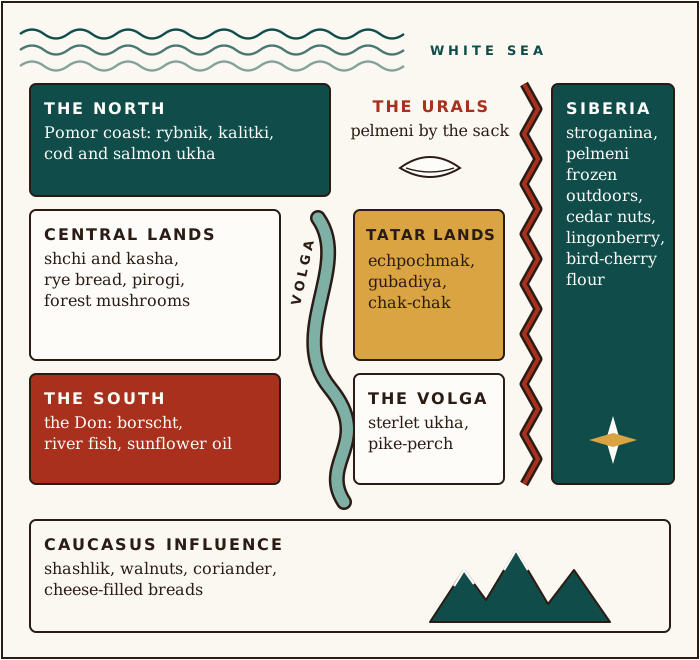
Draw one line from the White Sea down to the Caucasus foothills and another from the western forests out past the Urals, and you have crossed half a dozen kitchens that happen to share a language. The picture below is deliberately a diagram — blocks, a ribbon for the Volga — because the borders between cuisines are soft, and I would rather not pretend otherwise.
The North and the Pomor coast
Pomors are the old seafaring settlers of the White Sea shore, and their cooking begins with cod, halibut and salmon. The signature is rybnik: a whole fish sealed inside rye dough and baked, so that the crust works as both pot and plate. Kalitki, small open rye pies filled with potato or millet, come from neighbouring Karelia. Little is fried; nearly everything is baked or stewed slowly.
Central lands
The heartland around the old towns is the country of shchi, kasha and the big brick stove, which stays warm all day and favours dishes that sit and soften: stewed cabbage, baked milk, porridge with a crust. Rye bread is the constant companion, and mushrooms and berries from the forest fill the gaps between harvests.
The Volga
The river brought fish — sterlet and pike-perch for the clearest ukha — and it brought trade. Halfway down lie the Tatar lands, whose pastry is a tradition of its own: echpochmak, a three-cornered pie of meat and potato; gubadiya, a tall layered pie for celebrations; and chak-chak, fried dough bound with honey and piled into a hill.
The Urals
Ask anyone here about pelmeni and settle in. The small dumplings, pinched into the shape of an ear, were made by the hundred at the start of winter and frozen outdoors in sacks. The classic filling mixes three meats; the arguments are about onion, and whether the broth comes to the table with them.
Siberia
Siberia took pelmeni and made them a household industry, the whole family around one floured table. Frozen river fish shaved thin, called stroganina, belongs to the far north. Cedar nuts, lingonberries and flour ground from dried bird-cherry go into pies and sweets you will not meet further west.
The Caucasus influence
From the south came skewered meat — shashlik — along with fresh coriander, walnuts, sour plum sauces and cheese-filled breads. Much of it arrived through markets and summer travel, and by now a dacha table in July is hard to imagine without something grilled over coals.