The samovar and the second sitting
Tea reached Russia overland by caravan and stayed for good. It now closes every meal and fills every pause; “come for tea” means come and sit for two hours, and there will be food. The object at the centre of it, for some two centuries, was the samovar — the word means simply “self-boiler”.
How a samovar works
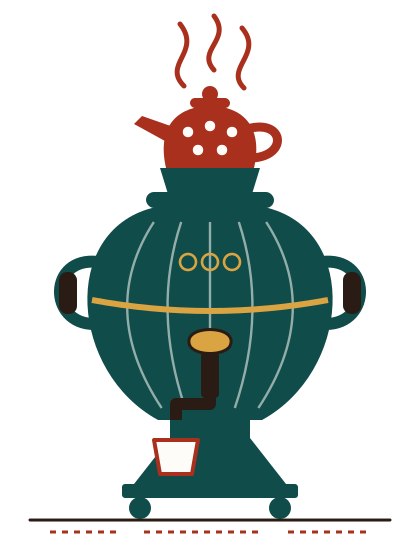
It is an urn with a chimney up the middle. Pine cones or charcoal burn in the central tube and heat the water around it; a tap at the front lets it out. On top sits a small teapot of zavarka, a very strong concentrate brewed from loose black tea. Each person pours a little zavarka into the cup and tops it up with hot water, so everyone has tea exactly as strong as they like.
Glasses and holders
At home tea may come in cups, but on trains it still arrives in a faceted glass set in a metal holder with a handle, the podstakannik. A slice of lemon is usual; milk is rarer. Drinking from the saucer to cool the tea belongs to old paintings and to grandmothers, who do it without apology.
What goes with it
Sugar was once taken “v prikusku”: a hard lump held in the teeth while the tea is sipped through it. Varenye is eaten by the spoonful between sips. Then the bread rings — sushki, small and hard, and bubliki, large and soft, both sold threaded on string — and pryaniki, spiced honey cakes stamped with a pattern; those from the town of Tula hide a layer of jam.
Herbs from the fence
At the dacha the teapot takes whatever grows nearby: blackcurrant leaf, mint, thyme, and fermented fireweed, ivan-chai, which was the everyday brew before tea leaves became affordable.
Zavarka for six
one small china teapot- loose black tea, heaped6 tsp
- water just off the boil400 ml
- blackcurrant leaves, optional3
- a folded towel1
Rinse the pot with boiling water. Add the tea, pour water to a third, wait a minute, then fill. Cover with the towel for five to seven minutes.
Pour a finger’s depth into each cup and fill up from the kettle. Top the pot up once; a second topping-up is frowned upon.